Sunday, March 8, 2009

Nematodes Resistant to Pesticides (and Evolution)


Dr. Palmer
I found this article on worms building up pesticide resistance. I wonder if we are seeing evolution working at incredible speed, or an ability of the worms to protect themselves.

http://www.theecologist.org/pages/archive_detail.asp?content_id=2034

Here's my input: This phenomenon is not due to random mutations following the exposure to the pesticide, which the writers of this article are implying allows for these nematodes to survive. Rather, evolution is a population effect, or a change in the overall dynamics of the population. Those nematodes that did not have that special "je ne sais quoi" certainly died off, leaving a greater percentage of nematodes that were better equipped to survive and reproduce. Hopefully this helps.

The Grandest Arthropods

The images are attached since i've collected them over the years.

First we have what a superficial internet search has told me is the largest crustacean the coconut crab.


Then there is the amazing psychedelic mantis shrimp. Some people keep them in domestic aquariums because of the colors.


Next up, a lot of textbooks with sort of north american bias like to show sow bugs/rolly pollies/woodlice as an example of isopods. This makes them look really meek and pathetic. But in Taiwan they raise and eat these giant isoods. With a little research apparently these are the suborder Calabozoida


Students Helping Students Study for Lab Practical


As I was studying for the lab I found some sites that I thought might help the other students.

interactive worm dissection
http://www.mhhe.com/biosci/genbio/virtual_labs/BL_14/BL_14.html

^crayfish dissection video (1 of 4) Related videos of this also include an earthworm, starfish, and clam. Essentially everything we need to know!
http://www.youtube.com/watch?v=6GQKy3nL7es&feature=related

Saturday, March 7, 2009

Leeches and More Leeches (Subclass Hirudinea)


Dr. Palmer,

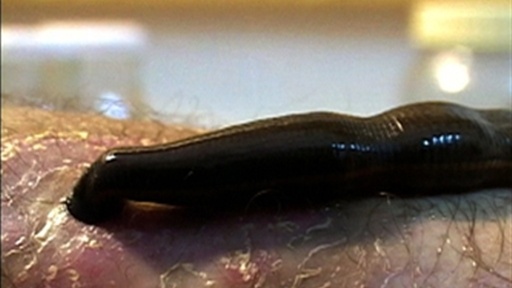
This video is incredible! It is a little gross, but it is a leech who has had a full blood meal and is actually excreting it on the floor of this man's home! It's a little tough to watch but is quite interesting.

http://www.youtube.com/watch?v=4GyocYjPXbM&feature=related

This video I also found interesting, it shows a leech trying to penetrate itself into a carpet python. It fails, but is a great example of the snakes able to defend itself from the leech!

http://www.youtube.com/watch?v=7BTOZHX2FLo&feature=related

I seem to be finding leeches quite interesting tonight!!! If I find any more neat videos I will be certain to pass them along!

Medicinal Use of Leeches in India


I found this national geographic video about the uses of leeches in India for medicine, and might I say, I think I'll stick to modern, western, medical techniques!!!

http://video.nationalgeographic.com/video/player/places/culture-places/work/india_leechescure.html

To be honest, I'm amazed that so many people still allow the leech therapies to be preformed on them. It seems so barbaric, and I tend to wonder how well it really works? I would be afraid to let it happen! Do you know if the leeches could actually infect you if they, say, had had a blood meal from someone who had aids? I know that's an odd question - but I tend to think it's an odd practice!!!

Annelid Comic Strip


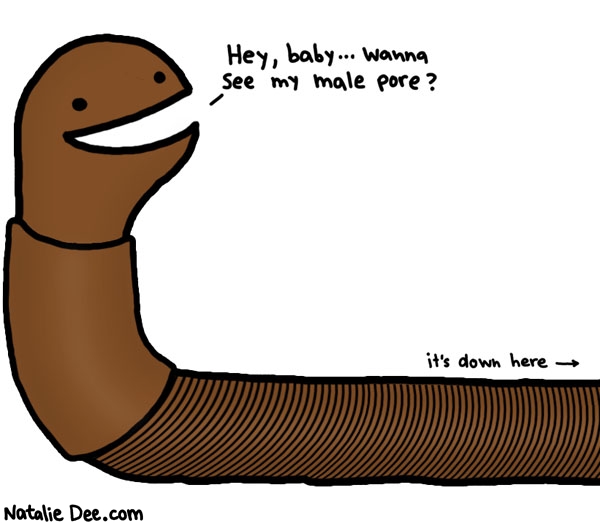
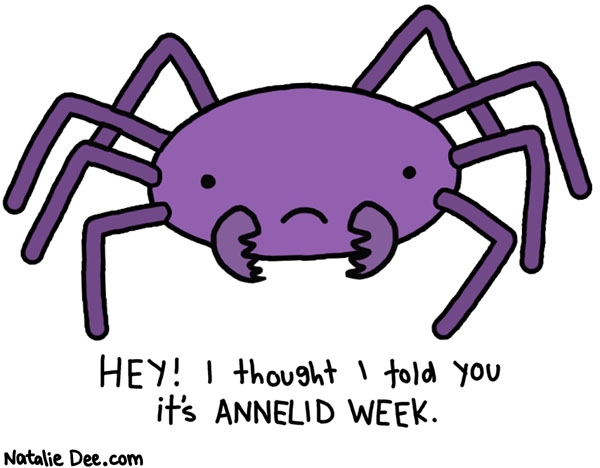
There's a funny web comic called Natalie Dee, and last month there was a special Annelid Week:

http://www.nataliedee.com/020509/annelid-week.jpg
http://www.nataliedee.com/020609/male-pore.jpg
http://www.nataliedee.com/020709/get-out-of-here-spider.jpg
http://www.nataliedee.com/020809/where-them-arms-come-from.jpg
http://www.nataliedee.com/020909/i-dunno-how-he-tied-that-cape.jpg
http://www.nataliedee.com/021009/why-is-that-rabbit-so-small.jpg
http://www.nataliedee.com/021109/true-love.jpg

Helpful Websites for Dissections


Here is an awesome link that lets you quiz yourself on the anatomy of a dissected clam

Clam

http://biog-101-104.bio.cornell.edu/biog101_104/tutorials/animals/clam.html

You can find almost all of the animals that we dissected in class online this way! Here are the links for the squid and crayfish.

Squid

http://biog-101-104.bio.cornell.edu/bioG101_104/tutorials/animals/squid.html

Crayfish

http://biog-101-104.bio.cornell.edu/bioG101_104/tutorials/animals/crayfish.html

If you google "Cornell University Dissections _______" (fill in the blank with the animal you want) the website will come up. It's a good way to quiz yourself outside of the lab with a real photo. I read that some schools provide these to students who object to actual dissections.